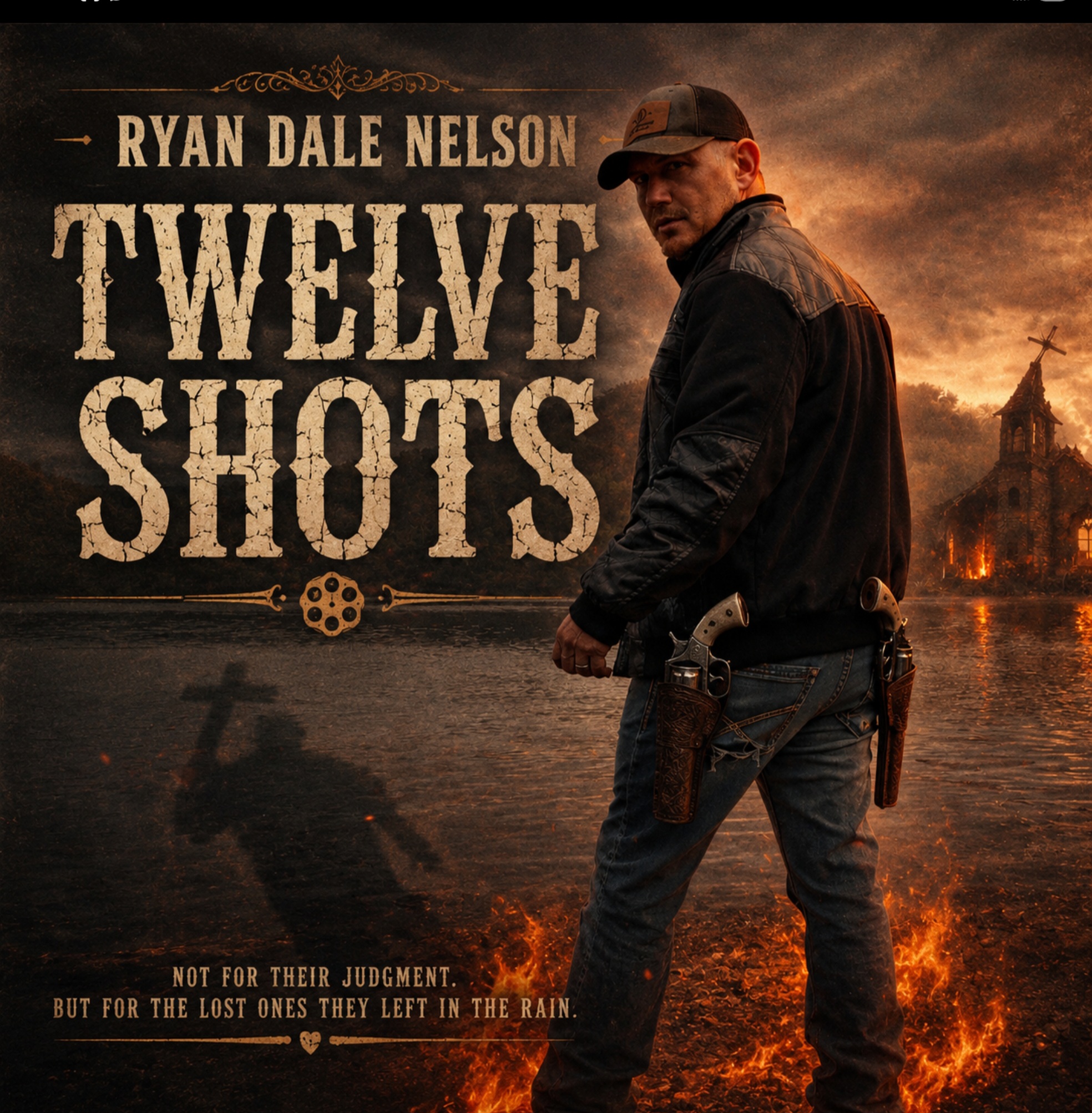
Video killed the radio star. Ryan Dale Nelson may be helping kill something else: the belief that an artist must spend years playing half-empty rooms, chasing co-writes and burning through tens of thousands of dollars before producing music capable of competing at a professional level.
Nelson’s methods have made him both an intriguing case study and an easy target. To supporters, he’s an independent artist exploiting technology exactly as artists always have. To critics, he’s taking shortcuts through a process musicians are supposed to suffer through. Either way, the experiment is becoming difficult to dismiss.
Before the Algorithm
Long before AI entered the conversation, Nelson was making music in Shawnee, Oklahoma. He began musical theater around 17 and continued into college. He later played in a four-man punk band before collaborating with guitarist Jeremy Ward on an industrial project influenced by Nine Inch Nails. Nelson handled sampling, keyboards, programming and drum machines while Ward supplied the guitar.
Then it stopped.
Nelson joined the Army. Ward became a pharmacist. For roughly two decades, music became part of Nelson’s past as careers, family, ministry and business took over.
Then, during one of the lowest periods of his life, Nelson began writing again.
What happened next is where the story becomes considerably more interesting.
He Didn’t Find a Shortcut, He Built One
Nelson returned with years of stories, hooks, melodies, unfinished verses and choruses. But instead of rebuilding his career using the traditional independent-artist playbook, he began constructing his own system.
AI-generated instrumentation allowed him to rapidly prototype demos. ChatGPT and Gemini became developmental tools for examining structure, syllable placement, rhyme, phrasing and timing.
After observing his process, I would estimate 75 to 85 percent of the core writing originates with Nelson: the stories, concepts, hooks, melodies and substantial portions of the lyrics. AI functions less like an autonomous songwriter and more like an unusually fast writing room.
That distinction is important.
Nelson isn’t asking a machine to make him famous. He’s using machines to eliminate thousands of hours between inspiration and execution.
And apparently, it worked.
The $50,000 Question
Developing an album traditionally isn’t cheap. Co-writers, demos, producers, engineers, musicians, studios and revisions can consume tens of thousands of dollars before an artist discovers whether the songs actually work.
Nelson reversed the equation.
He wanted the experimentation done before the expensive people entered the room.
Songs were repeatedly adjusted until the phrasing fit his voice, rhythms locked into place and choruses became easy to remember. Eventually, 13 songs emerged as structured demos.
Then Nelson went to Knoxville.
This is also where calling the finished product “AI music” becomes increasingly inaccurate. Those demos became blueprints for recordings made with professional producers and Nashville-connected musicians.
Real guitars. Real drums. Real fiddle. Real steel. Real bass. Real voices.
The machine didn’t replace the studio.
It prepared Nelson to walk into one.
Nashville’s Uncomfortable Question
And here is the part of Nelson’s story that matters beyond Nelson:
What happens when somebody without Nashville money suddenly has access to Nashville-level development tools?
For generations, money, geography and relationships served as music-industry gatekeepers. AI doesn’t eliminate talent or musicianship, but it dramatically reduces the cost of experimentation.
Imagine an artist approaching a label with finished songs, professional recordings, an established sound, audience analytics and listeners already waiting.
That’s considerably cheaper than building an artist from zero.
For executives, the economics are fascinating.
For some traditionalists, they’re terrifying.
The Enid Problem
Back home in Enid, Oklahoma, Nelson has taken considerable criticism over AI. The accusation is simple: “It’s AI.”
Nelson’s answer has largely been another release.
His song Enid attracted significant local attention. Jezebel Queen has reached radio audiences in Australia, while Dust & Iron has attracted television interest. Meanwhile, his listener base has grown despite minimal touring.
Nelson isn’t particularly interested in spending 200 nights a year on the road, either. He’s planning a limited four-week run and has made it clear that being home with his family matters more.
Twenty years ago, that decision could have ended an aspiring artist’s career.
Technology may now make it possible to build one anyway.
Don’t Ask Him to Make You Famous
Nelson has already been asked to help other artists replicate the process.
He’s selective.
His reasoning exposes another uncomfortable reality: a great song and a music career aren’t the same thing.
Nelson believes roughly half the battle is music. The other half is audience creation, branding and understanding the business.
You might have a phenomenal song, but if you’ve been unable to move beyond 29 monthly listeners, Nelson’s system alone isn’t going to rescue you.
AI can accelerate development.
It cannot manufacture determination.
The Hybrid Artist
That is why “Hybrid Artist” may ultimately be a more accurate description than “AI artist.”
Human experience. Human direction. AI-assisted demos. Human musicians. Professional production. Digital audience building.
Music history is littered with technologies once accused of destroying authenticity: electric instruments, synthesizers, drum machines, sampling, digital recording, Auto-Tune and bedroom studios.
Now the argument has reached AI.
Nelson may not ultimately be the most important artist produced by this shift.
That’s precisely why his story matters.
Because behind him will come the teenager in a tiny town, the mother with notebooks full of songs, the factory worker carrying melodies in his head and the veteran with stories but no Nashville connections.
Nelson didn’t invent artificial intelligence.
He did something potentially more useful.
He figured out how an independent artist could assemble existing technologies into a system capable of competing far above his traditional weight class.
Purists can call it cheating. Competitors can call it an unfair advantage. Executives may eventually just call it efficient.
History will decide which description survives.
But Ryan Dale Nelson has already demonstrated something that would have sounded ridiculous not long ago: an unknown independent artist in northwest Oklahoma can develop an entire catalog, assemble elite musicians, create professional recordings and begin building an audience without first spending years begging the traditional industry for permission.
Ryan Dale Nelson didn’t destroy the old music business.
He figured out how to go around it.
And if the next generation of independent artists follows him through that opening, the argument over whether he “cheated” may eventually seem almost quaint. Love him or hate him, the Hybrid Country Artist is here.
Follow Ryan Dale Nelson in Instagram: https://www.instagram.com/ryandalenelson/