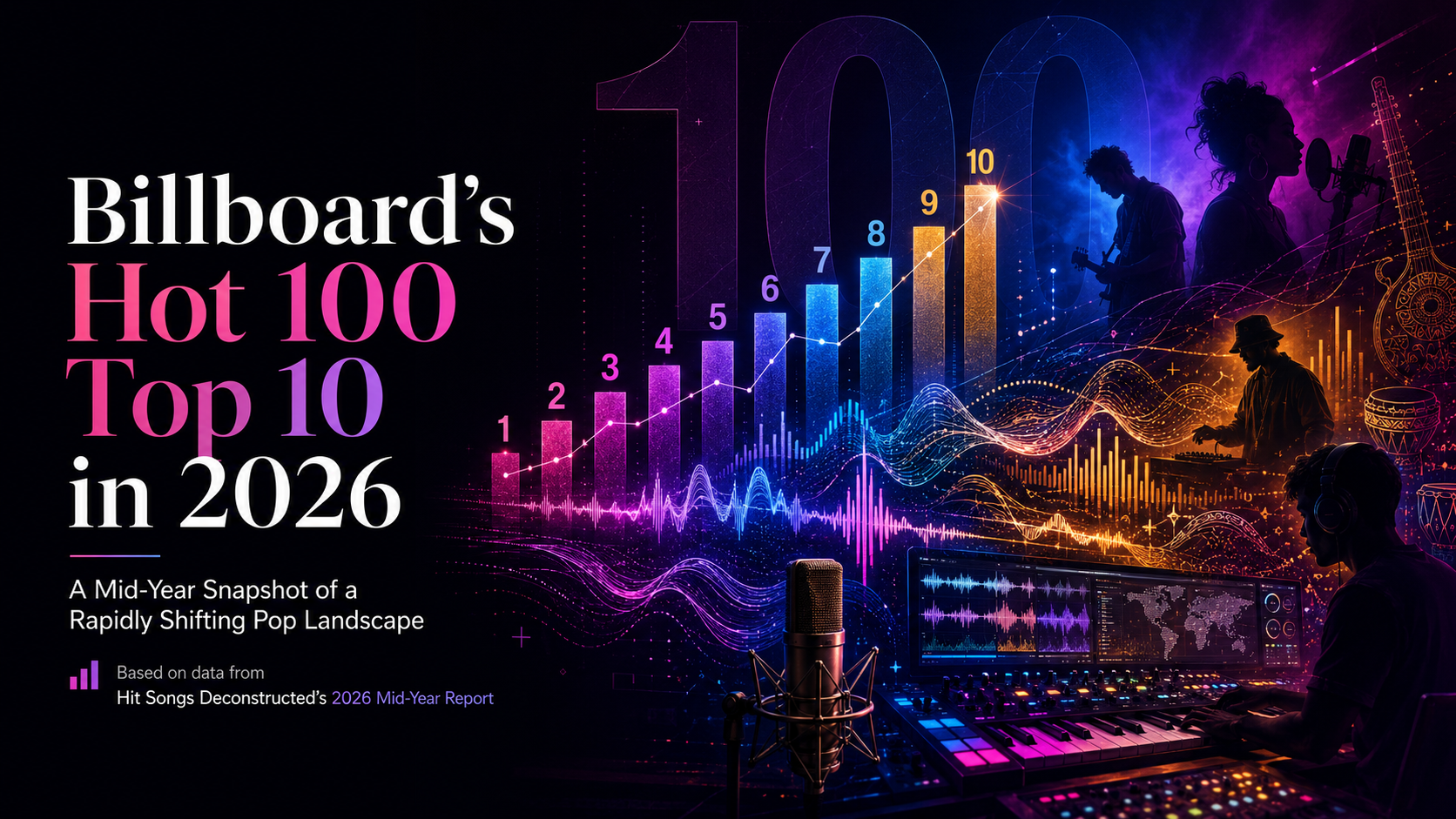
Based on data from the State of the Billboard Hot 100 Top 10: 2026 Mid-Year Report
The first half of 2026 has delivered one of the most dynamic and transitional periods for the Billboard Hot 100 Top 10 in recent memory. According to Hit Songs Deconstructed’s mid-year analysis, the year’s biggest hits reflect a marketplace in flux—where genre boundaries blur, songwriting teams shrink, and production trends evolve at a pace that mirrors the industry’s broader transformation.
Across January through June, 42 songs reached the Top 10, and 13 of them climbed all the way to No. 1. Behind those hits stood 25 performing artists, 85 credited songwriters, 97 producers, and eight record labels, each contributing to a soundscape that is increasingly diverse and less predictable than in years past.
Drake Dominates (Again)
If there was one constant in the shifting terrain, it was Drake. The Toronto superstar led all primary artists with nine Top 10 entries, accounting for 21% of all songs that reached the chart’s upper tier. He also topped the list of credited songwriters with nine songs.
On the production side, Daniel Nigro, La Paciencia, and MAG each contributed to four Top 10 hits, underscoring the increasingly collaborative nature of modern pop production—even as the size of songwriting teams shrinks.
Republic Records continued its chart dominance, responsible for 18 of the 42 Top 10 hits, giving the label a commanding 43% share of the chart’s most coveted real estate.
The Era of the Mega Writing Team Is Over
Perhaps the most striking shift of 2026 is the collapse of the five-plus-person songwriting team. For more than a decade, songs with five or more writers were the norm, never dipping below 37% of Top 10 hits. But in the first half of 2026, that figure plunged to 10%, the lowest level in over ten years.
This reversal suggests a renewed appetite for more streamlined creative processes, whether driven by artistic preference, industry economics, or the rise of multi-hyphenate writer-producers capable of handling more of the workload themselves.

Pop Still Leads, But the Genre Landscape Is Rebalancing
Pop remained the most common primary genre, but its dominance is slipping. In 2025, pop accounted for 42% of Top 10 hits; in 2026, that share fell to 33%.
The decline reflects a more balanced genre ecosystem shaped by seven primary genres and an impressive 29 sub-genres and influences. These influences spanned geography—Brazilian, Korean, Latin, reggaeton, salsa—and time periods ranging from the 1960s to the 2010s.
Three categories in particular gained significant ground:
- R&B/Soul: up from 28% to 40%
- Alt/Indie: up from 25% to 33%
- World influences: up from 13% to 21%
Songs like Olivia Rodrigo’s “Man I Need”, sombr’s “Back to Friends”, and Bruno Mars’ “Risk It All” exemplified this trend toward more eclectic sonic palettes.
Short Songs Fall Out of Favor
After years of shrinking runtimes, driven in part by streaming economics, 2026 marks a reversal. Songs under three minutes accounted for just 14% of Top 10 hits, the lowest share in nearly a decade.
Even chart-toppers like Taylor Swift’s “I Knew It, I Knew You” and BTS’s “Swim” bucked the trend, opting for more expansive structures.
Choruses Arrive Later Than Ever
One of the most notable structural shifts is the delayed arrival of the first chorus. The average first chorus now lands at 0:51, and the share of songs that wait until the one-minute mark or later more than doubled—from 14% to 31%.
Tracks such as HUNTR/X’s “Golden”, Olivia Rodrigo’s “The Cure”, and Noah Kahan’s “The Great Divide” exemplify this trend toward slower builds and more patient storytelling.
Instrumental Intros Hit a New High
Instrumental-only intros reached their highest level in over a decade, appearing in 62% of Top 10 hits. Nearly all songs (95%) began with some form of intro, but the rise of instrumental openings marks a shift toward mood-setting and atmospheric production.
Examples include Ella Langley’s “Choosin Texas”, Alex Warren’s “Ordinary”, and Taylor Swift’s “The Fate of Ophelia”, all of which debuted at No. 1.
A Chart in Transition
Taken together, the data paints a picture of a chart undergoing meaningful evolution. The dominance of pop is softening. Genre influences are diversifying. Song structures are stretching. And the era of sprawling songwriting teams appears to be fading.
For songwriters, producers, and industry strategists, the 2026 mid-year trends offer a clear message: the Hot 100 is rewarding experimentation, cross-genre fluency, and more individualized creative voices. The hits of 2026 are actively reshaping the sound of mainstream music.
If the first half of the year is any indication, the rest of 2026 will continue to challenge long-held assumptions about what a hit sounds like. and who gets to make one.